Lake Chelan Mirror
It was the only time in World War I or II that an enemy aircraft was shot down — air to air — with pistols.
The young American pilot named his tiny plane Miss Me!?, with the hope Germans’ bullets would fly far from his unarmed Piper L-4 Cub. Lieutenant Duane Francies wanted the folks back home to miss him too.The explanation point and question mark duo tacked at the tail of his plane said both.
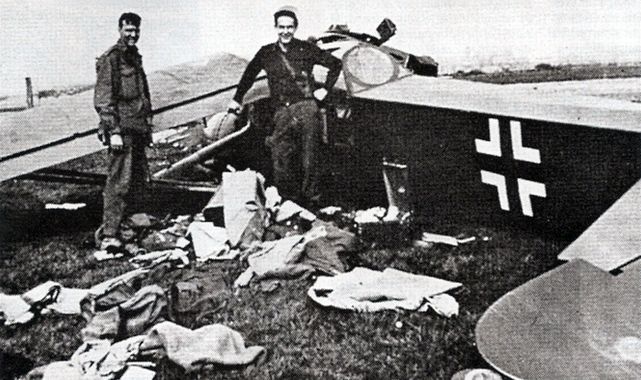
Chelan’s Francies and Miss Me!? made history in 1945, when he and his observer used Colt 45 pistols to shoot down a German plane in the last dogfight between Americans and Germans in World War II.
Francies and his observer Lieutenant William Martin were part of the 5th Armored Division, the first troops to reach Luxembourg, Germany and fight through the Siegfried Line. Sometimes referred to as Patton’s ghost troops or the “First Army Wedge,” the 5th kept a low profile for security reasons. The vehicles were unmarked; the soldiers didn’t wear shoulder patches. There were not reporters allowed.
“We were the ghost army,” said Francies.
Silhouetted against a window framing Lake Chelan, Francies, now 81 years old and living at Heritage Heights, seemed comfortable surrounded by piles of airplane books and magazines. A painting of his historic air fight hung on a nearby wall. He glanced at it as he told his story.
It was April 11, 1945, and he was flying his 142nd mission. Francies and his observer were flying 100 miles from Berlin, looking for enemy targets. All was quiet — until Francies spotted a German motorcycle speeding from a wooded area close to American tanks.
The two men flew in for a closer look, swinging wide to sneak up from behind. Focusing on the motorcycle with its attached sidecar, they didn’t see the other plane at first. It seemed to appear from nowhere.
The aircraft was a German Fieseler Fi-156 Storch artillery spotting plane, about 200 feet above the trees. It was bigger and faster than Miss Me!?. The engine was three times as powerful.
“He could have thumbed his nose at us and kept flying,” said Francies, “but he tried to outmaneuver the Cub. That’s a hard thing to do.”
Francies and Martin radioed they were about to give combat. Then, taking advantage of altitude, Francies dove on the German plane. He and Martin tripped open their side doors and grabbed their Colt 45’s from their shoulder holsters. They opened fire, blasting on the German plane, wanting to force it into firing range of the nearby American tanks. But the German pilot kept circling.
The American swooped down on the plane and fired several shots from the open side doors, Francis holding the stick between his knees while reloading. The German plane was about 15 feet away. It was close enough for Francies to see its pilot’s eyes. “They were huge,” he said.
Francies and Martin fired as fast as they could pull their triggers. They knocked out the Storch’s windshield. It collapsed, cutting the pilot’s face. They shot the plane’s engine department and the right fuel tank; the German observer was hit in the foot.
Spinning low, the Storch’s right wing slammed into the ground. It broke off, and the plane cartwheeled, landing in a field.
Francies landed Miss Me!? nearby, and the two men ran to the German plane. The pilot had dived behind a pile of beets. At gunpoint, he came out with his hands over his head. They found the German observer lying in a ditch. Francies removed the soldier’ boots, and a 45 slug dropped out, unable to penetrate the thick sole of his army boot. Francies bandaged the observer’s foot.
After American troops rolled to the crash site in their tanks, Francies and Martin turned the two airmen over as prisoners of war. They also pulled several stacks of German military records from the plane, as well as a massive red, black, and white German battle flag with a swastika. Francies still has the flag in a safety deposit box.
The dogfight was documented in Cornelius Ryan’s best-selling 1986 book named The Last Battle. Francies and the observer both received the Distinguished Flying Cross.
Francies’ drama with aircraft started when he was 10 years old. Growing up in Wenatchee, he heard a radio announcement that Clyde Pangborn and Hugh Herndon, Jr. would land in East Wenatchee after completing the first nonstop transpacific crossing from Japan. Francies’ mother took him to the site, along with most of the kids in town. He remembers watching the pilot belly land the Bellannca Skyrocket on a sandy hill overlooking the Columbia River. It was Oct. 5, 1931.
“I’ve seen flying grow up,” said Francies.
He rode in a plane for the first time when he was 12 years old. It was a Ford TriMotor. After that, there was no question. Francies knew he wanted to fly.
When the local college offered civilian flight training for prospective Army and Navy fliers in 1940, Francies jumped at the chance. He signed up for the first class. He earned his pilot’s training certificate on Feb. 3, 1941.
Three days after the Japanese bombed Pearl Harbor on Dec. 7, 1941, Francies enlisted. After basic training and a three-month furlough to burgeoning enlistments, he was sent to glider pilot training.
“That’s an awful quiet profession,” he said. “You can’t go where you want to. You just go down.”
A bit disheartened, Francies traveled to Kansas and Texas for training. He and the other pilots used Cubs to fly to 3,000 feet. There, they cut the engines and glided to the ground, over and over and over. They often trained at night, the planes shining like fireflies. Sometimes there were as many as 60 planes slicing through the dark over the landing field.
Officers split the class and asked for volunteers to join the artillery. Francies jumped at a chance to fly behind an engine. “I thought 65 horsepower was better than zero,” he said.
In spring 1943, Francies began in the California desert training with General George Patton, assigned to the 5th Armored Division to replace a pilot who was killed while flying too low. Francies was sent to more training in Tennessee, New York and New Jersey. He arrived in Liverpool, England in Feb. 1944.
He was assigned to the 71st Armored Field Artillery Batallion as an artillery spotter. Flying Piper L-4 Cubs with 65-horsepower, four-cylinder Continental engines, Francies and the other observation pilots flew ahead of the 5th Armored Division. They searched for targets, directed artillery fire, and led the division’s tank forces.
The pilots often had to make dangerous landings in fields, many of them mined, to refuel. They would borrow a gallon or two of gasoline from American soldiers along the route and take off again. Dodging enemy bullets became routine.
Francies was shot down once during the war. He was flying alone, and an anti-aircraft hit his plane’s engine. Landing in a field, Francies didn’t know who would find him. Fortunately, American forces saw him go down. Three tanks moved to the crash site and formed a circular shield around the pilot. A soldier leaned out. “Lay down,” he said.
Francies did, and as one of the tanks rolled close, he crawled toward an escape hatch under the deck. The American soldiers reached down and pulled him through to safety.
Francies’ accomplishment include saving an American officer under fire. While flying ahead of the artillery on Sept. 19, 1944, he spotted Lieutenant DeSales Harrison lying wounded in a field. Francies landed his plane about a mile away, found an American jeep, and asked soldiers to drive him as close as possible to Harrison. Francies crawled 200 yards down a ditch to where he lay under enemy fire. He told Harrison to hold on to his belt and dragged him to safety. Francies was awarded the Bronze Star for his action.
“We were over there to do a job,” said Francies, “and we wanted to do it as well as we could. I learned you never give up, ever.”
Photo: Francies (right) stands next to the German plane he and his observer shot down. Photo courtesy of The Lake Chelan Mirror.
The full version of this story was published in The Lake Chelan Mirror.
 Celeste Hankins, Writer, Nature Guide & Yoga Teacher