House Calls
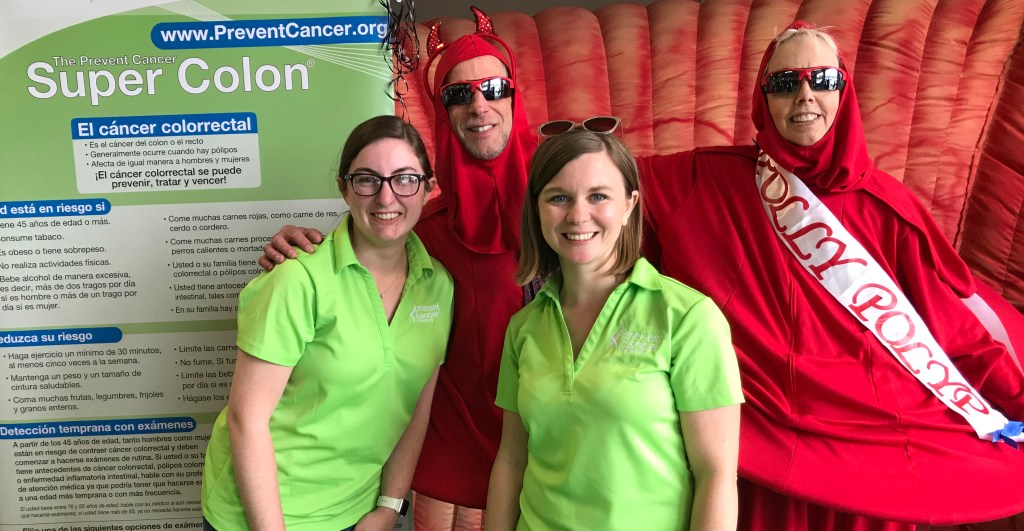
Anita Mitchell’s alter ego is a polypoid polyp, one of the most common types of polyp found in the large intestine. A polyp is a small grape-like clump of abnormal cells. A polypoid looks like a little red mushroom attached to the colon’s lining by a thin dangling stalk. It’s a tricky thing to turn into a costume, said Anita, who had two custom polyp suits designed for her nonprofit organization Colon STARS.
Anita visits elementary schools across Washington state as Polly Polyp. A fit, woman in her early 50’s, the colon cancer survivor wears bright red sneakers, red sweatpants, and one of the droopy, red-hooded polyp costumes to teach kids about colon health. She wears a Miss America-type sash strung across her chest and uses garden hoses, tennis balls and pop-up tunnels as teaching tools. Anita, aka Polly Polyp, and I met over the phone.
I already had bowels on the brain. That’s what happens when your personal colonoscopy rears up against prep for the local hospital’s colon cancer prevention fair. Searching online for toilet paper graphics to use on promotional flyers, I had poop emojis on my desk and a gallon of Colyte solution, a bowel-cleansing drink, to guzzle before my routine screening. Talking to Polly Polyp was all in a day’s work.
It started two months earlier when I met general surgeon Dr. Tabetha Bradley outside of radiology. “I heard about giant inflatable colons you can walk through,” she gushed, “like The Magic School Bus for grownups. That’s so cool! Do you think you can get one?”
It was the most animated I’d ever seen the young doctor. She was almost bouncing, corkscrew curls flying loose from her tight ponytail, reminiscent of Miss Frizzle herself. I wanted to make her colon dream come true, so I began making phone calls to get to the bottom of the challenge. Turns out, renting a mega-sized colon is expensive, about $6,000 an event. But I lucked out on my third try. I called PreventCancer, a non-profit organization located in Washington DC. Each year, they choose two hospitals to visit free of charge with their 20-foot inflatable colon, and our hospital met their criteria.
So, on June 20, Chelan Hospital will host a 10-foot tall pop-up, super-sized colon. Visitors with enough guts can tunnel through the inflatable large intestine, which weighs almost 150 pounds. In the bowels of the exhibit, visitors will learn more about pre-cancerous conditions and various stages of colon cancer, as well as prevention and early detection.
Colon cancer, or cancer of the colon and rectum, is the third most common cancer in the United States, according to the American Cancer Society, and the second leading cancer killer in the country. It’s also one of the most preventable and treatable cancers if detected early. That’s because it begins as small, benign polyps that can easily be removed before turning into cancerous cells, said Bradley.
Colonoscopies are the gold standard in colon cancer prevention. When you have a colonoscopy, your doctor inserts a long, flexible tube called a colonoscope into your rectum. The scope, made of multiple strands of fiber optics, displays an image on an external screen so your doctor can view the inside of the colon. During the procedure, your doctor looks for polyps and removes any she may find using a wire tool with a loop on the end, which she threads through the colonoscope. Removing polyps means they won’t turn into cancer.
Anita wasn’t that lucky. She was diagnosed with stage 4 colon cancer in her early 40’s, well before the age of 50, when routine screening was recommended at that time. The suggested age is now 45, according to the American Cancer Society. It’s earlier if you have a family history of colon cancer. Unaware of her family history of colon cancer, Anita had no reason for early screening, which could have prevented the cancer from developing, or detected it at an earlier, more treatable stage, she said.
After Anita survived cancer, she created Colon STARS, a nonprofit corporation with the mission to save lives by educating people on the importance of colorectal cancer screening. They have their own inflatable walk-through colon, along with the two Polly Polyp costumes which Anita graciously offered to package and ship to us for our colon cancer prevention fair. She’s full of creative ideas. Poop emoji door prizes. Toilet paper displays to “wipe out colon cancer.” A bowl of chocolate candy with a sign that reads, “Take a tootsie, but make sure yours is checked!”
“It’s okay to make colon cancer prevention fun,” assures Anita, who is getting ready to place her own order for poop emoji stress balls. “Poop is popular right now. You walk down the toy aisles at Walmart and find it everywhere: games, slime, pool floaties.”
Even so, things intestinal remain a taboo subject for most people. That may be why about one in three adults from 50 to 75 years old still hasn’t been tested for colorectal cancer, according to the Centers for Disease Control and Prevention. More than 90% of cases occur in people who are 50 years old or older, and they often don’t show any symptoms in the early stage.
When 52-year-old Tamara Wolfe of Manson ended up in the emergency room at Chelan Hospital with an ulcer a few years ago, the doctor recommended she get a colonoscopy. Tamara refused. “Everyone told me the prep was awful, and the test was invasive,” she said. “And I didn’t have any symptoms. I didn’t think I needed one.”
A busy grandma of six, Tamara was enrolled in an online veterinary assistant training program. Between studying, grandmothering and selling her homegrown blueberries at the local farmers market, two years passed before she saw a doctor again, this time for a minor hernia.
During the exam, general surgeon Bradley, like the ER doctor, recommended a colonoscopy, but Tamara turned it down. However, when labs uncovered serious anemia, Bradley and Tamara’s family physician Dr. Tobe Harberd insisted she at least take a stool sample test. The results showed blood in the stool, and her medical team refused to operate on the hernia until she had a colonoscopy. Tamara finally agreed to the test.
Harberd performed the screening. As he carefully thread the colonoscope through the ascending colon, he found a mass so large it blocked the camera’s passage. He had to reverse and exit after clipping a snippet to biopsy.
Tamara waited impatiently for the results. When the phone rang the next day, Harberd had bad news. Tamara had Stage 2 colon cancer, meaning it had already spread throughout the organ. “My whole world crashed down around me,” she said. “I started to bawl. The first words out of my mouth were, ‘Am I going to die?’”
Bradley operated on Tamara soon after, removing her ascending colon, part of her small intestine called the cecum, and her appendix. Tamara was lucky. The cancer hadn’t spread outside of the bowel. They caught it just in time, she said. “If I’d put off a colonoscopy one more time, that would have been it.”
Now, almost two years cancer free, Tamara lives with a heavy routine of tests, blood work, CT scans and colonoscopies. She worries daily about the cancer coming back. It especially hits first thing in the morning, she says, when she wakes up. Every time she feels an ache or a twinge, she wonders if it’s cancer. “This all could have been avoided if I had agreed to a colonoscopy when the doctor first suggested it,” she said. “They would have found the polyps earlier and removed them. If I had any advice, it would be to get your colonoscopy as soon as you can. It’s not that bad, and it may save your life.”
You are at higher risk of colon cancer if you’re 50 or older, are overweight or a smoker, or have a personal or family history of colon polyps or colon cancer. Younger people are exhibiting polyps more often, and researchers think it may be related to diet, lack of exercise and alcohol consumption. While many people with colon cancer do not experience any symptoms in the early stages, symptoms include rectal bleeding or blood in the stool, persistent abdominal discomfort, weakness, unexplainable weight loss, a change in bowel habits or stool consistency. Contact your doctor if you experience these symptoms.
 Celeste Hankins, Writer, Nature Guide & Yoga Teacher