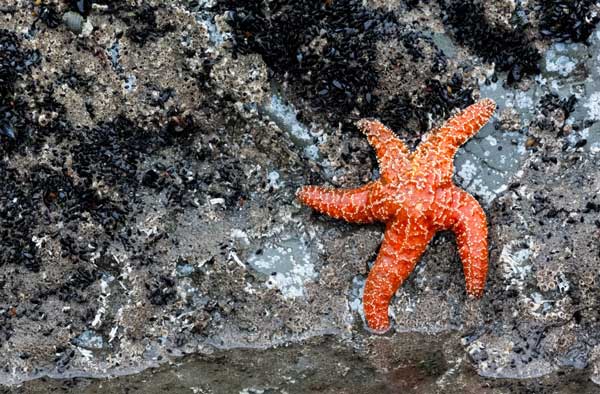
Excerpt from Personal Essay: My Feet in the Stars
…Biologist Melina Giakoumis stood just offshore, knee-deep in the Atlantic Ocean. Bundled in bib waders attached to rubber boots, she searched for sea stars that might be hiding alongside a five-meter red rope. She’d placed the transect line parallel to the shoreline at Pretty Marsh, a rocky intertidal zone in Maine’s Acadia National Park. Giakoumis turned over each stone in a 10-meter square and watched for the purple and brown sister species, Asterias forbesi and Asterias rubens. Sea stars—once known as starfish—will hide under rocks, she told me, especially the babies. Some as small as the tip of your finger.
But I couldn’t find any rocks to flip at Otter Point, a rocky shoreline about 20 miles southeast of Pretty Marsh. I scrabbled over mammoth slabs of granite and tugged at stone outcroppings. They wouldn’t budge. So, I climbed closer to the ocean. I wanted to find a sea star. Other students in my science-writing residency were touring a genetics lab, but I opted out. I was still struggling with memory gaps and brain fog from Long COVID. My days as a fast-paced reporter seemed behind me, and I struggled to keep up with my coursework. Finding a sea star, however, seemed doable. A five-pointed, five-lined child’s drawing tucked into a pocket of sea water, perhaps briefly abandoned by the outgoing tide.
I began my search at Otter Point because it’s one of six intertidal monitoring sites in the national park. For more than a decade, researchers have tracked flora and fauna on these craggy, rose-colored rocks. The stony surfaces resemble dragon scales, or even miniature cliff cities. Bits of embedded quartz glimmer throughout like scattered diamonds. As I moved across the intertidal zone, I felt like I was trekking across star-studded elephant skin. This fringe of earth is the space between high tide and low tide. It’s often not even found on maps nor nautical charts, said Hannah Webber, the marine ecology director at Acadia’s Schoodic Institute. “It truly is a space between.”
In the intertidal zone, saltwater surges out and drifts back in twice a day, as the moon spins and tugs at the ocean. I sat down cross-legged at Otter Point and faced the tide pulsing outward. A salty breeze cooled my skin. I closed my eyes in that liminal land of contrast, where animals have adapted to survive both hot, baked terrain and the cool cover of sea. I listened to the heartbeat clang of a bell buoy. I slid my palms across the water and wind-shaped stones, their surfaces strangely askew. Like a fractured Picasso. When I opened my eyes, I saw a flash of light and discovered three metal discs on a nearby sunlit stone. Each was about the size of a quarter and drilled into the rock, about half a meter apart. I visually connected the silver orbs. One, two, three, across, like Orion’s Belt. I realized these were markers identifying the research site.
I found my first official tidal pool a few meters away. It bloomed like a pair of 70’s bell bottom pants: a riot of sunflower yellow, rust, and patina green. Dozens of licorice-colored mussels clung to the sides of the stone basin. Ghost-like hermit crabs scurried in the shade, and barnacles swept the water with fan-like feet. Periwinkle snails bearing galaxy-spiraled shells hid under the phytoplankton and seaweed that floated on the surface, but I couldn’t find a sea star. I scouted out a dozen more tidepools, yet no luck. It was a sea star bust.
***
Giakoumis told me, when she first started her fieldwork, it took almost a year to find a sea star. Was it because their population was declining? Because the Gulf of Maine is warming 99 percent faster than the rest of the global ocean, as Andrew Pershing, an oceanographer at the Gulf of Maine Research Institute in Portland, Maine, discovered in 2014?
To find out, Giakoumis replicated a 1979 sea star survey by researcher Bruce Menge. She partnered with Acadia’s Schoodic Institute and the National Park Service and surveyed 13 beaches along the Northern Atlantic in 2021. She weighed and measured each sea star she and her assistants found. Then she compiled the data and calculated each beach’s sea star biomass.
The results were startling, she said. “In an area like Pretty Marsh, where we were excited to find dozens of sea stars, that paled in comparison to what must have been hundreds, or thousands, of sea stars Menge found on beaches in the 1970s.”
Sea stars are echinoderms, related to sea urchins, sand dollars, and sea cucumbers. The star-shaped animals have thousands of tiny tube feet attached to their underbellies. Those feet propel them across the ocean floor in a slow crawl that relies on a simple nervous system: a nerve ring around the mouth and radial nerves extending to each arm. Like most invertebrates, sea stars do not have brains.
In contrast, a human brain is composed of about 100 billion nerve cells, or neurons…
Excerpt from Personal Essay: Visit Two Springs and Call Me in the Morning
In 1890, guests paid eight dollars a week to find an antidote at Longmire. They bathed in the springs and guzzled the water. For an extra four dollars, the “afflicted” could access a saddle-horse train to the resort, National Park Service (NPS) histories recall. Transportation began in the town of Yelm, about 50 miles away. For each journey, workers loaded ponies with flour bags, pots and pans, and crates of chickens. Other horses carried women in voluminous Victorian-era skirts up the wandering trail toward the mountain and the springs.
The health resort was named after pioneer James Longmire, who discovered the pools in 1883, after his first summit of Mt. Rainier, before the land was turned into a national park. According to legend, Longmire was following historic Native American trails and looking for a lost horse when he stumbled upon the site. The explorer found the bubbling pools as he emerged from the surrounding forest of Douglas fir, western red cedar, and alder.
At the time, natural springs were already a national health craze, with visitors flocking to hot springs in Georgia and Arkansas. Longmire recognized a money-making opportunity. He filed a mineral claim to gain access to the land. Five years later, the federal government awarded him a patent for 18 acres. The allotment included most of the area’s 40 mineral springs and the adjacent low-lying wetland. The pools were rich in sodium bicarbonate — known as baking soda and still sometimes prescribed by doctors as an antacid — as well as iron and other minerals.
Longmire and his family cleared a trail through the forest, and by1885, they were building a rustic health spa, according to Wonderland: An Administrative History of Mount Rainier’s National Park. The family constructed a two-story hotel from split logs, not far from the skunk cabbage and cattails growing in the wetland. Then they sunk cedar-planked tubs into the mineral springs and covered them with shack-like bathhouses, adding boardwalks across the property. Historical photographs show that, as the number of guests outgrew the original inn, the family added cabins and square white tents to the resort. They also built cobbled stone structures around some of the pools, which varied in temperature from 50 to 85 degrees.
Visitors soaked in the brackish water and bathed in the mud. After enjoying a massage, they could use a wooden “snorting” pole to clear their sinuses. Sulphureous fumes billowed from the pipe stuck deep into the earth. “Taking a whiff” of the gases “nearly took the top of your head off,” remembered one guest quoted in an NPS history about the still-standing Longmire Cabin.
James Longmire wasn’t shy about promoting the resort’s medicinal properties. He shipped bottles of the mineral water to a doctor in Chicago to support the claim that “there’s medicine in every drop.” The response from the physician has been lost, but by 1890, the family was heralding the health spa as “Nature’s Own Laboratory” in the nearby Tacoma newspaper. In a photo of the original advertisement—now displayed near the historical site—the Longmires declared the mineral water could cure those “afflicted with rheumatic pains, catarrh, piles, and other afflictions that have been pronounced incurable.”
Why go abroad,” it asks, “when you may find Nature’s own restoratives at your very doors.”
***
As I snowshoe through the ruins of the Longmire Resort, I wonder how much truth there is to the published claims. I visit the nearby Longmire Museum to learn more. It’s a small wooden building with a pitched roof and a porch supported by sturdy pillars. Inside, it smells like old books and leather and taxidermy. I meet park ranger Darby Robinson. He’s a young man with a backpack, and an open smile, and he wears his wide brim hat tipped far back on his head. He’s excited to tell me what makes the bubbling springs bubble.
The process starts, he explains, when rain and snow percolate through the earth’s crust on the mountain’s upper slopes. Then the volcano’s magma creates heat that warms the water as it travels downward. As the fluid circulates through cracks in underground rock, it dissolves surrounding minerals, until it reaches Longmire, Robinson says. There, it mixes with shallow, cold groundwater before reappearing. The pockets of volcanic gases pop like champagne when they discharge from the springs.
Surely, I think, some of this must make the pools medicinal. “Do you ever drink the water?” I ask Robinson.
“Oh no, no, no,” he exclaims, laughing.
While some visitors do imbibe—Robinson says he once caught people trying to smuggle water out of the park in gallon jugs—there are traces of arsenic in the springs that suggest caution. The water temperature also doesn’t reach high-enough temperatures to kill bacteria.
In addition, Robinson tells me, the NPS sent two water samples to the Bureau of Chemistry’s Hygienic Lab in Washington D.C. even back in 1920. The results were questionable. After follow-up correspondence with the Public Health Service, according to the NPS’s Wonderland, officials concluded drinking the water at Longmire did not have medicinal value, “other than the natural benefits that were incidental to a restful and relaxing sojourn in a mountain resort.”
But what about bathing in the springs or snorting volcanic fumes, I wonder. Did visitors to the Longmire resort find health relief in other ways…
Excerpt from Personal Essay: Waiting for Whales with Moon Girl
…I grabbed two pair of binoculars from the bookshelf and stuffed them in a backpack, along with three mismatched mittens. Then we rushed from the house and sped to the nearby marina at the Alderbrook Resort, located at mile post seven on the state highway. We arrived at high tide. It was misty and 42 degrees. We stood alone on the dock, and I waved my phone high above my head to get a signal.
Where were the whales?
“Milepost nine, south shore,” I saw, as my phone updated. “Heading west still, 3:33 PM.”
Killer whales can sprint up to 30 miles per hour, but most often, they swim three to four miles an hour. When they visit Hood Canal, they may travel even more slowly, depending on the direction of the ocean currents, and whether the whales stop to hunt. These orcas were not salmon-eating Southern Residents. They were a pod of five Bigg’s transients, the third group of killer whales that frequents the Salish Sea. Instead of diving deep to forage salmon, these marine mammals hunt and eat seals and sea lions in shallower water. This pod was a group known as the T68C’s, a mother killer whale called Bazan, according to the Orca Network, and her offspring: Sila, Jacobsen, Rich, and a calf born two years earlier.
Zoe and I waited for the family to arrive. We sat cross-legged, next to one another, on the gently-rocking dock. I wanted to ask Zoe a question, but I hesitated. Finally, I reached out and took her hand. I gave it a squeeze.
“Did you resent me when I got sick?” I asked, quietly.
“No,” she answered and shook her head in disbelief. “You taught me to be a caring person. I saw someone I loved struggling and wanted to help. That’s all.”
“Hmm,” I said, holding tight to her hand.
We settled into silence. The sun set behind our backs, and a full moon began to rise. It cast its light across the sea. We shivered and snuggled against one another to stay warm. Almost an hour passed, and we took turns wearing the third mitten. Then, Zoe spotted the whales through her binoculars.
“There they are,” she whispered, pointing east. I searched the horizon until I found the small, black triangles. We followed the fins as the whales swam closer and then paused midway across the canal. For 30 minutes, the pod stayed nearby. We gasped as the animals hunted and slapped their tails against the water. Observing from shore felt wilder—and quieter—than seeing killer whales from the Blackfish Express. The mother and her offspring dove and resurfaced multiple times, releasing their fishy exhales into the air. I listened for the whoosh I remembered, but the whales were too far away…
 Celeste Hankins, Writer, Nature Guide & Yoga Teacher